How China Is Quietly Turning Foreign Influencers Into Soft-Power Assets
From harness stunts on 56th-floor balconies to monorails slicing through apartment towers, Chongqing has become the backdrop of a new wave of viral travel content — and Beijing is paying close attention to who is filming.
By Board of Creators ·
Key takeaways
- Chongqing has overtaken Beijing and Shanghai as the most-filmed Chinese city on TikTok and Instagram in 2026, per Le Monde's on-the-ground reporting.
- Local tourism bureaus — not central propaganda agencies — are the ones courting foreign creators with logistics, access and visa-free entry.
- Gen Z audiences are forming their image of China almost entirely from undisclosed or under-disclosed travel content, raising FTC and EU DSA exposure for creators.
- Signature stunts like the 56th-floor harness shots and the Liziba "train through a building" clip crop out safety platforms and context, eroding audience trust over time.
- The same playbook is being run by Saudi Arabia, the UAE and several European city-marketing boards — China's version is just the most algorithmically refined.
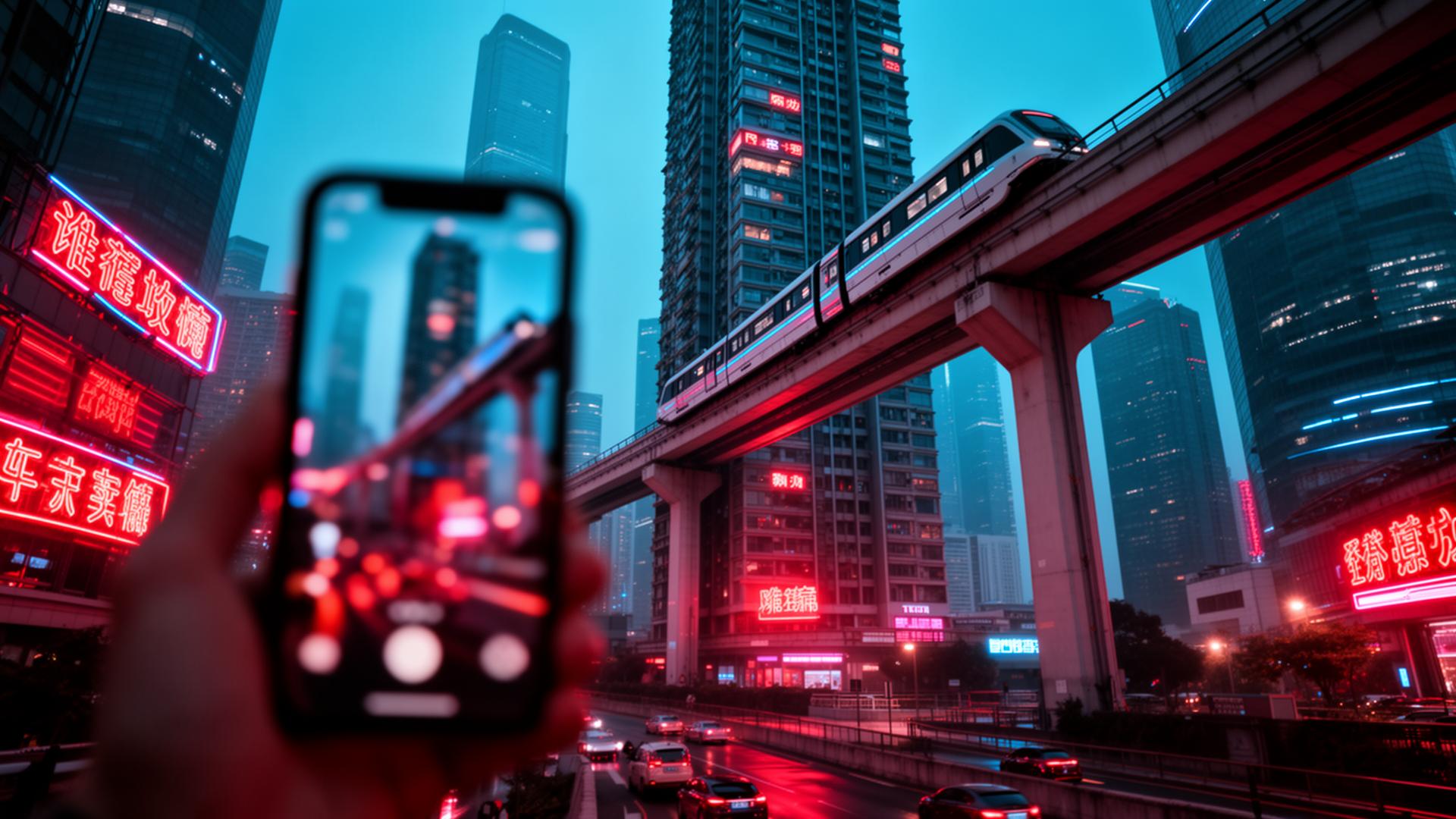
A Filipina creator dangles in a harness from the 56th floor of a Chongqing tower, a Ghanaian blogger gasps as a monorail glides through an apartment building, and a leather-clad rider poses on a motorcycle while the city''s neon-lit skyline burns behind him in slow motion. None of it looks like state propaganda. That, according to a new investigation by Le Monde''s Harold Thibault, is exactly the point.
Chongqing, the new face of "Cool China"
For most of the last decade, foreign travel content out of China stuck to a familiar shortlist: the Bund in Shanghai, the Forbidden City in Beijing, the karst cliffs of Guilin. In 2026, the algorithmic center of gravity has shifted 1,500 kilometers inland to Chongqing — a sprawling megacity of skyscrapers, cable cars and infrastructure that photographs like a video-game level.
The viral set pieces are now well-rehearsed. Influencers strap into safety harnesses on the Wanyou Conrad Hotel''s 56th-floor ledge and crop out the platform just beneath their feet. They line up at Liziba station, where Line 2 of the metro famously threads through a residential tower, and film the "train through the building" with the same wide-eyed reaction shot. Filipina creator Janina Manipol, who has close to 300,000 Instagram followers, captioned her May 18 harness photo, "This isn''t AI… It''s me, calmly hanging at the top of a skyscraper." Ghanaian blogger Zionfelix, with 2.6 million followers, told his audience on May 3 that "China is full of wonders" over a clip of the elevated metro.
Why the trend matters beyond travel
On the surface this is just another destination trend — the kind that has previously made Tulum, Bali or Lisbon inescapable on a Gen Z feed. The reason Le Monde''s reporting matters for the creator economy is that the same generation that increasingly distrusts traditional news is forming its mental image of China almost entirely through these clips. The country becomes, by repetition, "vast, futuristic, electric, surprisingly easy to visit" — and very rarely anything more complicated than that.
"This fascination is helping to shape the country''s image among Generation Z, a demographic that gets its information via TikTok and Instagram rather than through traditional media." — Harold Thibault, Le Monde, May 26, 2026.
A soft-power playbook hiding in plain sight
Beijing has spent years experimenting with how to project a friendlier image abroad after the pandemic-era collapse of inbound tourism and a wave of negative coverage on Xinjiang, Hong Kong and tech crackdowns. The current approach, as documented by Le Monde''s on-the-ground reporting in Chongqing, leans on three quietly effective levers:
- Visa-free entry. Expanded transit and short-stay visa-free policies for dozens of countries have made spontaneous, "I just booked a flight" content possible again.
- Local government hospitality. Municipal tourism bureaus, not the central propaganda apparatus, are the ones courting creators with logistics help, drivers and access — a softer touch that rarely shows up on camera as a sponsorship.
- Algorithmically perfect cityscapes. Chongqing''s vertical geography is genuinely unusual, which means even unpaid creators reliably produce content that flatters the country''s modernization story.
The result is a feed full of posts that almost never feel political, yet collectively perform the work of a state communications campaign.
What creators are — and aren''t — disclosing
This is where the story converges with debates we''ve been tracking on Board of Creators around political-influencer disclosure and the collapse of generic influencer credibility. A trip arranged or partially comped by a Chinese regional tourism board is, under both U.S. FTC guidance and the EU''s Digital Services Act, a material connection that should be disclosed. In practice, the captions Thibault documents read like organic travel diaries.
For creators, the practical risk isn''t a Beijing-shaped scandal — it''s the same one Dr. Becky Kennedy and others have flagged for the wider category: audiences are getting faster at sniffing out undisclosed arrangements, and a single screenshot of a tourism-board itinerary can undo a year of "authentic" positioning.
A checklist for creators traveling on someone else''s dime
- Disclose the host, every time. "Hosted by [agency/bureau]" in the first line of the caption, not buried in a hashtag block.
- Separate the spectacle from the story. The monorail is genuinely cool. The political context around press freedom, Xinjiang or Taiwan is genuinely complicated. Conflating the two is what turns travel content into soft power.
- Keep your own footage. If a host offers polished b-roll, treat it the way you''d treat a brand-supplied asset — label it, don''t pass it off as your own capture.
- Read the room on safety stunts. The 56th-floor harness shots crop out the safety platform. Audiences increasingly reward creators who show the rig, not the illusion.
The bigger pattern
China is not the only government to figure this out. Saudi Arabia''s tourism push, the UAE''s creator residency programs and a growing list of European city-marketing boards are all running variations of the same play: skip the press release, fly the creators in, let the algorithm do the rest. Le Monde''s Chongqing dispatch is useful because it captures the most sophisticated version of this strategy in 2026 — one where the state''s fingerprints are almost invisible because the content genuinely is fun to watch.
For the creator economy, the question is no longer whether influencers can move soft power. It''s whether the disclosure norms, audience literacy and platform rules will catch up before the next viral skyline does.
Sources & credits
- Primary reporting: Harold Thibault, "How China uses influencers to polish its image," Le Monde (English edition), May 26, 2026 — special correspondent in Chongqing. Subscription required for the full investigation.
- Creators referenced in the original investigation: Janina Manipol (Instagram), Zionfelix (Instagram).
- Related Board of Creators coverage: As political influencers rise, regulators want tighter payment rules; AI just killed the influencer category — and built something better in its place.
This article synthesizes the publicly available portion of Le Monde''s investigation and adds creator-economy context. For the full reporting from Chongqing, please read and support Le Monde directly.